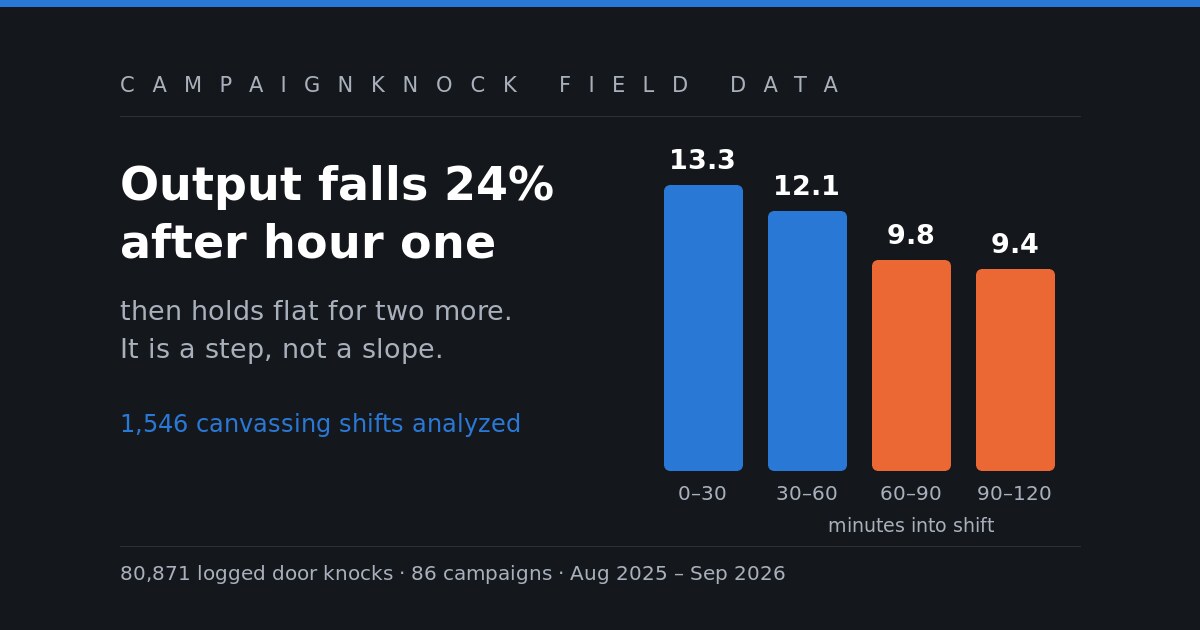
We looked at 1,546 real canvassing shifts to find out when a canvasser's output actually drops. The answer surprised us: it is not hour three, and it is not gradual. Output falls about 24% after the first hour, then holds flat for at least two more.
The received wisdom is that canvassers wear down steadily — that you get diminishing returns the longer someone walks. The data says something different and more useful.
What happens over a shift
Among shifts lasting two hours or more, here is the knock rate in each half-hour:
| Time into shift | Doors knocked | vs first 30 min |
|---|---|---|
| 0 – 30 minutes | 13.3 | — |
| 30 – 60 minutes | 12.1 | −9% |
| 60 – 90 minutes | 9.8 | −26% |
| 90 – 120 minutes | 9.4 | −29% |
The first hour produces about 25 doors. The second produces about 19. That is a 24% fall.
Then it stops falling. Looking only at shifts that ran three hours or more, the third hour holds at roughly the same 19 doors as the second. Canvassers settle into a sustainable rate and stay there.
So how long should a shift be?
If output steps down after an hour and then holds, two shorter shifts should beat one long one. The numbers say they do, modestly:
- One three-hour shift: roughly 25 + 19 + 19 = 63 doors
- Two ninety-minute shifts: roughly 35 each = 70 doors
About 10% more doors for the same total walking time, because you get two fast first-hours instead of one. Not transformative — but free, and it also asks less of volunteers in a single sitting, which matters more for whether they come back.
Most shifts already end early
Campaigns are, without quite meaning to, already doing this. Across 1,546 shifts:
| Shift length | Share of shifts |
|---|---|
| Under 1 hour | 20.7% |
| 1 – 2 hours | 33.6% |
| 2 – 3 hours | 24.2% |
| 3 – 4 hours | 11.6% |
| 4 hours or more | 9.8% |
The median shift is 38 doors over 111 minutes. More than half end inside two hours, and only one in five runs past three.
So the practical advice is not “cut your shifts down” — most are already short. It is: stop treating the short shift as a failure. A volunteer who gives you 90 focused minutes is operating in the most productive part of the curve. Asking them for four hours does not get you twice the doors, and it is a far harder ask to repeat next week.
Why does output drop after an hour?
We can measure the drop but not its cause, so here are the candidates honestly:
- Conversations. A canvasser who is getting doors answered spends time talking. Early knocks may simply hit more empty houses and move faster. Our availability data is too noisy across shift-time to confirm this either way.
- Turf density. Canvassers often start on the dense, easy part of the turf and work outward into streets with longer walks between doors.
- Warm-up and logging. Some of the early rate may be enthusiasm, and some may be logging behaviour that tails off as the shift goes on.
- Actual fatigue. Plausible for the initial drop, but fatigue should compound, and after hour one this curve does not.
Our best read is that it is mostly the first two. But we are not going to claim a mechanism we cannot measure.
What to do with this
- Schedule 90-minute shifts by default. They sit entirely in the fast part of the curve and they are an easier ask.
- Put them in the evening. Shift length is worth about 10%; knocking at 6pm instead of 2pm is worth nearly double the availability. The timing data is here.
- Do not stretch a good volunteer. Two 90-minute shifts a week beats one three-hour shift on doors, and beats it by more on retention.
- Start on the dense turf. If early-shift speed comes partly from short walks between doors, front-loading density is free throughput.
How we calculated this
- Defining a shift: a canvasser's consecutive logged interactions with no gap longer than 60 minutes. 1,546 shifts of 10 or more knocks.
- The decay curve: 699 shifts of at least 15 knocks lasting two hours or more, so every half-hour bucket reported has the same number of shifts underneath it — no survivorship effect from shifts ending early. The three-hour plateau uses 330 shifts of at least 20 knocks running three hours or more.
- Source data: 81,191 logged door interactions from 82 campaigns and 166 canvassers, August 2025 to September 2026, converted to each canvasser's local timezone. Shift analysis needs only timestamps, so it uses the full dataset — unlike our availability figures, which are restricted to campaigns that record empty doors.
Ninety minutes, in the evening, on dense turf. Then stop.
Analysis by CampaignKnock, based on 1,546 canvassing shifts drawn from 81,191 logged door interactions across 82 campaigns, August 2025 to September 2026. Figures may be cited with attribution.