There is no universal answer, but there is arithmetic — and the arithmetic is simpler than most first-time candidates expect. This post shows you how to calculate your own number, then shows what campaigns actually do, using data from 86 real campaigns.
School board races are won on margins that would be rounding errors in a congressional race. Turnout is low, the electorate is small, and a few hundred votes routinely decides the seat. That cuts both ways: the number of doors you need is achievable, and the number your opponent needs is too.
The arithmetic: four numbers
Work backwards from votes, not forwards from effort.
- Votes to win. Take turnout from the last comparable election for your seat — not a presidential year, the same kind of election. Divide by the number of candidates, then add a cushion. Your county clerk publishes this.
- Your persuadable universe. Not every registered voter. The people who actually vote in school board elections, minus those already locked to an opponent.
- Contacts per vote. Field research consistently finds door-to-door canvassing moves votes at a meaningful but modest rate — it takes many conversations to net one additional vote. Plan on needing far more conversations than the margin you are chasing.
- Doors per conversation. This is the one most people get wrong, and it is the one we can measure.
How many doors equal one conversation?
From our data, roughly one door in six to one in three comes back marked nobody home, depending heavily on when you knock:
| When you knock | Nobody home |
|---|---|
| 1:00 – 4:00 PM | 31.2% |
| 5:00 – 8:00 PM | 18.0% |
On top of that, a share of the people who do answer will not engage. Budget for it. If you need 400 real conversations and you canvass in the afternoon, you are knocking close to 600 doors to get there — and around 490 if you knock in the evening. The timing data is here.
A worked example
A seat where 4,000 people voted last cycle, two candidates.
- Votes to win: about 2,001, so target 2,200 with a cushion
- Assume roughly a third of that electorate is genuinely persuadable: ~1,300 voters
- Reaching them at an evening miss rate of 18.0% means knocking about 1,590 doors
- Nobody is home first time for many of them, so plan a second pass: ~2,000 door attempts
Two thousand door attempts. One person knocking 25 doors an hour needs about 80 hours. Spread over a 12-week campaign, that is under 7 hours a week. With three volunteers it is barely two hours each.
That is the honest scale of a school board race. It is a lot of walking, and it is entirely doable by a small team that starts early.
What campaigns actually do
Here is where the plan meets reality. Across 82 campaigns in our data:
doors knocked by the median campaign
of their own voter list the median campaign ever reaches
canvasser on the median campaign
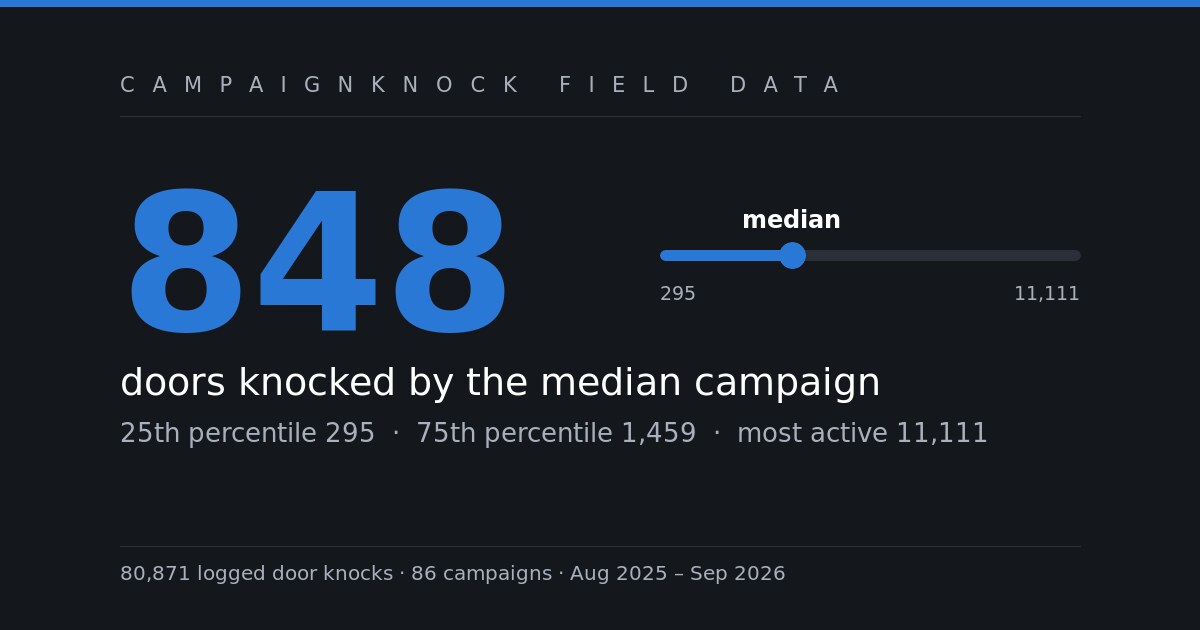
The median campaign knocks 848 doors. The quarter that work hardest knock more than 1,459, and the most active campaign in our data knocked 11,111. The quietest quarter stop under 295.
More telling: the median campaign touches only 14.4% of the voter list it loaded. Campaigns import their universe, look at how many names are in it, and then reach about one in seven of them.
And the median campaign is one person. Not a team — a candidate with a phone, walking their own district.
So what is the number?
For a typical small school board seat, plan on 1,500 to 2,500 door attempts and build the schedule backwards from your election date. If your district is larger, run the arithmetic above rather than borrowing someone else's number.
But the more useful finding is this: at 848 doors, the median campaign is not close to covering its universe. If you knock 2,000 doors in a school board race, you are almost certainly outworking the field.
Three things that waste the effort
- Knocking in the afternoon. Nearly twice the miss rate of an evening knock, for the same walking.
- Canvassing Friday. The worst day in our data, with 36.9% of doors empty.
- Not recording who you spoke to. A second pass is where school board races are won, and you cannot run one if you do not know which doors already answered.
How we calculated this
- Doors per campaign: 54 campaigns with at least 50 logged door interactions. Median 848, 25th percentile 295, 75th percentile 1,459, maximum 11,111.
- List coverage: 53 campaigns with at least 200 voters loaded and 50 doors knocked; median share of loaded voters ever visited was 14.4%.
- Team size: 82 campaigns with logged canvassing; median distinct canvassers was 1, maximum 19.
- Availability rates: from the 10 campaigns that record empty doors (55 canvassers, 29,572 knocks). Most campaigns log a status only when something notable happened, so pooling them understates the miss rate. Volume figures use all 81,191 interactions across 82 campaigns.
Run the arithmetic. Knock in the evening. Beat 848.
Analysis by CampaignKnock, based on 81,191 logged door interactions from 82 campaigns between August 2025 and September 2026; availability rates from the 10 campaigns that record empty doors. Figures may be cited with attribution.