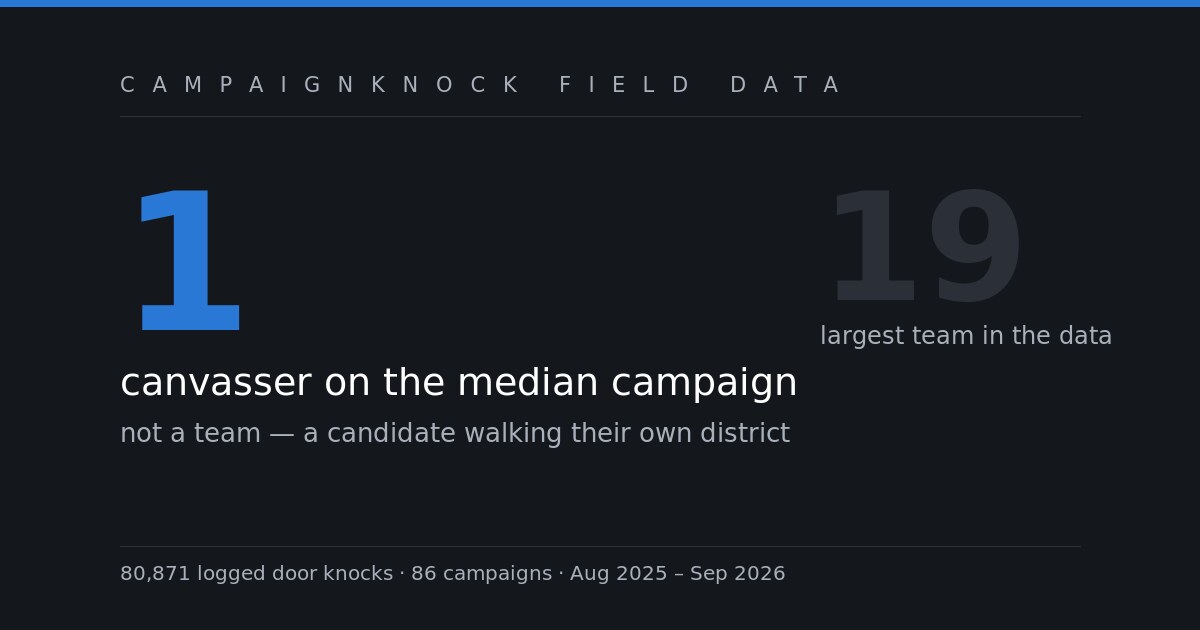
Running for mayor means a citywide electorate and, for most first-time candidates, a team of about one. In our data the median campaign has a single canvasser, and the largest has nineteen. This is how to make a citywide canvass work when you cannot knock everything.
You cannot cover a city. Stop planning as if you can.
A ward candidate can realistically touch every door. A mayoral candidate usually cannot, and the campaigns that fail are the ones that spend eight weeks pretending otherwise before panicking in October.
Across 82 campaigns, the median has one canvasser and knocks 848 doors. The hardest-working quarter clear 1,459. Even the most active campaign in our data — 11,111 doors — would not cover a mid-sized city's electorate.
So the citywide question is not “how do we knock everything?” It is “which 15% do we knock, and why that 15%?”
Choose your universe deliberately
The median campaign already reaches about 14.4% of its loaded list. The difference between a good citywide campaign and a poor one is not the percentage — it is whether that percentage was chosen or whatever happened to get walked.
Rank precincts by two numbers, then knock in that order:
- Turnout rate in comparable past elections. Persuading a reliable voter is worth several times persuading someone who will not vote.
- Margin volatility. Precincts that swing between cycles are where canvassing changes outcomes. Precincts that break 80/20 every time are not worth your evenings either way.
High turnout plus high volatility is where a small team earns its keep. Work down that ranked list and stop when you run out of weeks — the list guarantees that whatever you did not reach was the least valuable turf.
A one-person schedule that actually holds
At 25 doors an hour, evening canvassing four nights a week plus Saturdays is about 20 hours and 500 doors a week. Over a 12-week campaign that is 6,000 door attempts — more than seven times the median campaign, from one person keeping a disciplined schedule.
Where volunteers actually come from
The median campaign has one canvasser because most candidates ask for help the way they would ask a favour — vaguely, once, and apologetically. The campaigns in our data with real teams got there by asking for something specific and small: one turf, one evening, a fixed number of doors, a defined end time.
“Can you help with the campaign?” gets a maybe. “Can you take these 60 houses on Thursday between 5:30 and 7:30?” gets a yes or a no, and either is more useful.
Knock the schedule, not the map
| Day | Nobody home |
|---|---|
| Saturday | 17.2% |
| Tuesday | 20.6% |
| Wednesday | 22.3% |
| Thursday | 23.5% |
| Sunday | 27.8% |
| Monday | 33.2% |
| Friday | 36.9% |
For a campaign with limited hours, dropping Friday and Monday entirely and moving those evenings to Saturday is the cheapest improvement available. The full timing analysis is here.
How we calculated this
- Team size: 82 campaigns with logged canvassing. Median distinct canvassers 1, maximum 19.
- Doors per campaign: 54 campaigns with at least 50 logged interactions. Median 848, 75th percentile 1,459, maximum 11,111.
- Coverage: 53 campaigns; median 14.4% of loaded voters ever visited.
- Availability by hour and day: from the 10 campaigns that record empty doors (55 canvassers, 29,572 knocks); most campaigns log a status only when something notable happened, so pooling them understates the miss rate. Volume figures use all 81,191 interactions across 82 campaigns.
Rank the precincts. Knock evenings and Saturdays. Ask for specific shifts.
Analysis by CampaignKnock, based on 81,191 logged door interactions from 82 campaigns between August 2025 and September 2026; availability rates from the 10 campaigns that record empty doors. Figures may be cited with attribution.