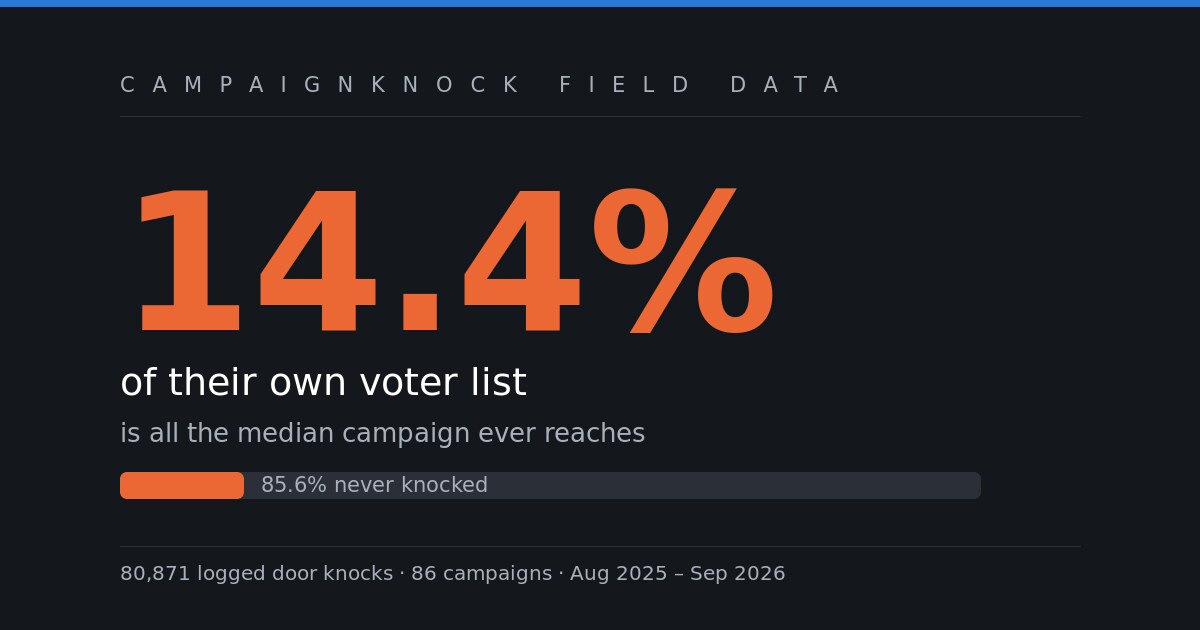
A city council ward is the most winnable race in American politics and the most commonly under-canvassed. Across 82 campaigns in our data, the median one reaches just 14.4% of the voter list it loaded. This is how to cover a ward properly with a small team.
A ward is small enough to cover completely. Almost nobody does.
That 14.4% figure is the single most damning number in our dataset. Campaigns import their universe, see the size of it, and then knock about one door in seven. The list is not the problem. The plan is.
Ward races are the one level where full coverage is genuinely achievable. The median campaign in our data loaded 986 voters. At an evening miss rate, covering 986 households twice is roughly 2,100 door attempts — about 85 hours of walking, or under three hours a week each for a candidate plus two volunteers across a 12-week campaign.
Split the ward before you knock, not during
The failure mode in ward canvassing is not laziness, it is fragmentation. Volunteers pick streets that are convenient, the same blocks get hit twice, and a third of the ward never gets touched at all. Nobody notices until the last week.
- Divide by turf, not by volunteer. Cut the ward into blocks of roughly 60–80 households — one evening shift. Assign turf to people, never people to whatever is left.
- Sequence by density first. Apartment blocks and dense streets produce more conversations per hour walked. Do them while volunteer enthusiasm is highest.
- Hold back 20% for the final fortnight. Not untouched turf — your best turf, for the second pass when persuasion actually sticks.
When to knock a ward
From 81,191 logged door interactions, availability varies more by hour than by anything else you control:
| Window | Nobody home | Verdict |
|---|---|---|
| 5:00 – 8:00 PM | 18.0% | Protect this block |
| 1:00 – 4:00 PM | 31.2% | Nearly double the miss rate |
| Saturday (all day) | 17.2% | Best day of the week |
| Friday | 36.9% | Worst day — skip it |
A ward campaign that knocks Saturdays and weekday evenings, and skips Fridays entirely, will cover the same turf with roughly half the wasted trips. Full hour-by-hour data here.
Multi-unit buildings are where wards are lost
Most wards contain apartment blocks, and most campaigns quietly skip them because access is awkward. That is a large, concentrated, frequently younger and more persuadable slice of the electorate being handed to whoever bothers. Dense buildings also produce the best doors-per-hour numbers of any turf type once you are inside.
Track coverage, or you do not have a plan
The reason the median campaign reaches 14.4% of its list is not that canvassers are slow. It is that nobody can see the gap until it is too late to fix. Coverage is the only field metric worth reporting weekly: what percentage of the ward has been attempted at least once, and what percentage has been attempted twice.
If you cannot answer both of those on any given Monday, you are not running a field programme, you are running a walking club.
How we calculated this
- Coverage: 53 campaigns with at least 200 voters loaded and 50 doors knocked. Median share of loaded voters ever visited: 14.4%.
- List size: 134 campaigns with at least 100 voters loaded. Median 986, 25th percentile 100, 75th percentile 6,748.
- Doors per campaign: 54 campaigns, median 848, 75th percentile 1,459.
- Availability: from the 10 campaigns that record empty doors (55 canvassers, 29,572 knocks); most campaigns log a status only when something notable happened, so pooling them understates the miss rate. Volume figures use all 81,191 interactions across 82 campaigns.
Cut the turf first. Knock evenings. Measure coverage weekly.
Analysis by CampaignKnock, based on 81,191 logged door interactions from 82 campaigns between August 2025 and September 2026; availability rates from the 10 campaigns that record empty doors. Figures may be cited with attribution.