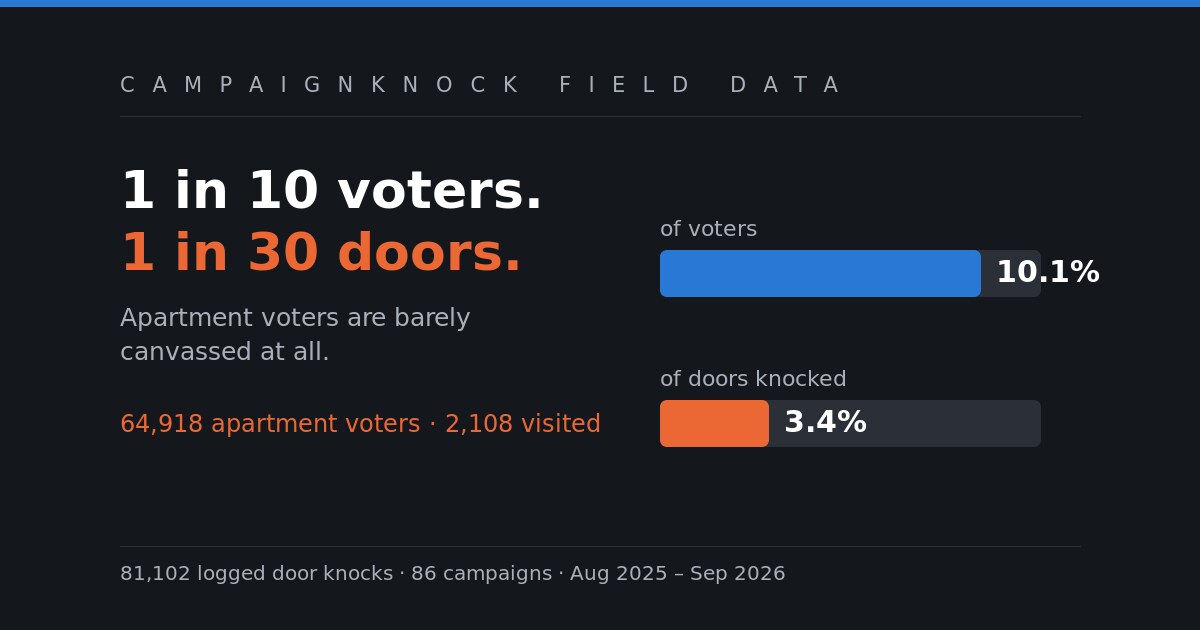
Apartment dwellers are one in ten voters on the lists campaigns load, and one in thirty of the doors they actually knock. We went looking for whether apartments are harder to canvass. What the data shows is that they are mostly not canvassed at all.
The gap
Across 82 campaigns, we classified every address in the loaded voter universe as multi-unit (an apartment, unit or suite number, or seven or more voters at one street address) or single-family. Then we compared the share of the universe with the share of the knocking.
| Share of voter universe | Share of knocking | Ever knocked | |
|---|---|---|---|
| Single-family | 89.9% | 96.6% | 12.5% |
| Multi-unit | 10.1% | 3.4% | 3.2% |
A voter who lives in a house is roughly four times more likely to have their door knocked than a voter who lives in an apartment. Multi-unit addresses make up 64,918 voters in these campaigns. Just 2,108 of them were ever visited.
Are apartments actually harder?
This is where we have to be careful, because the obvious reading of our data is wrong.
Among knocks that were logged with an outcome, multi-unit addresses show a lower nobody-home rate than houses — 4.2% against 13.5%. Taken at face value that would say apartments are easier.
They are almost certainly not. The number is a survivorship artefact: you cannot log “nobody home” at a door you never reached. A locked lobby, a broken buzzer or a no-soliciting policy produces no record at all. What our data captures is the subset of buildings a canvasser got inside — and once inside a building, people are indeed home, because they are stacked fifty to a stairwell and you are knocking in the evening.
The honest version: we can measure how little apartment canvassing happens. We cannot measure how hard it is, because the failures are invisible to us.
Why the gap exists
Nothing here is mysterious, and none of it is laziness:
- Access. A locked lobby ends the visit. A house never does.
- Turf cutting. Walk lists are built around streets. A single address holding 40 voters does not fit a route the way a block of 40 houses does, so it gets left for later and later never comes.
- Address quality. Unit numbers are the first thing to go missing in a voter file. A canvasser standing in a lobby with a name and no apartment number cannot proceed.
- Perceived return. Renters are assumed to be lower-turnout, so they are cut first when time runs short — which becomes self-fulfilling.
Why it is worth fixing
A concentration of voters behind one door is, on paper, the most efficient turf available. Forty units in one building means no walking between doors at all. The campaigns in our data that did get inside logged conversations at a high rate.
It is also uncontested. If 3.2% of apartment voters are being reached, your opponent is not reaching them either. In a race decided by a few hundred votes, a building with 60 voters in it is not a rounding error.
What actually works
- Fix the unit numbers before you walk. An address without a unit number is not a door. Clean those records first or the visit fails in the lobby.
- Ask the building, not the door. Management companies and resident associations will sometimes permit a scheduled visit, particularly for a local candidate. It is a phone call, and the downside is a no.
- Treat a building as one turf. Assign it to a volunteer as a unit of work with its own start and end, rather than burying it inside a street route where it will be skipped.
- Knock in the evening. The same finding as everywhere else — and more so where a single trip determines whether the whole building gets covered. The timing data is here.
How we calculated this
- Classification: an address counts as multi-unit if the street address carries an apartment, unit or suite designator, or if seven or more voters share that street address within the same campaign. Everything else is single-family.
- Universe: 645,386 voters loaded by the 82 campaigns that logged canvassing — 64,916 multi-unit, 580,470 single-family.
- Knocking: 81,191 logged door interactions, of which 2,726 were at multi-unit addresses. Coverage is the share of each group ever visited at least once.
- Window: August 2025 to September 2026.
street_address2 field was unusable — several campaigns repurposed it to store party codes. And as above, buildings a canvasser could not enter leave no trace at all, which is precisely the population this post is about.
One in ten voters. One in thirty doors. Nobody is competing for them.
Analysis by CampaignKnock, based on 81,191 logged door interactions and 645,386 loaded voter records across 82 campaigns, August 2025 to September 2026. Figures may be cited with attribution.